policy
Highland Council rules out short-term let control area for Black Isle and Easter Ross
The Black Isle and Easter Ross Area Committee has upheld its 2025 decision after a one-year evidence review found conversion rates of new homes to short-term lets below the Highland average.
The Highland Council has ratified its decision not to designate a Short Term Let Control Area across the Black Isle and Easter Ross, after an evidence review found the area's conversion rates remain below the Highland average.
The Black Isle and Easter Ross Area Committee agreed at its meeting on 9 November 2026 not to progress a control area covering all or part of the area. The decision followed an update to the report first presented to the committee in November 2025, when members concluded there was no justification for a designation.
According to the council, there were 442 licensed short-term lets across the Cromarty Firth, Tain and Easter Ross, and Black Isle wards as of July 2026, up from 428 in July 2025. Most are detached dwellings or unconventional accommodation such as pods and chalets.
Councillor Lyndsey Johnston, Chair of the Black Isle and Easter Ross Area Committee, said: "Our decision must be led by the local evidence, which clearly shows that short-term lets in the Black Isle and Easter Ross remain well below the Highland average and are not currently driving local housing pressures."
She said the committee had agreed to keep the data under continual review so it could act if local market conditions change.
The figures
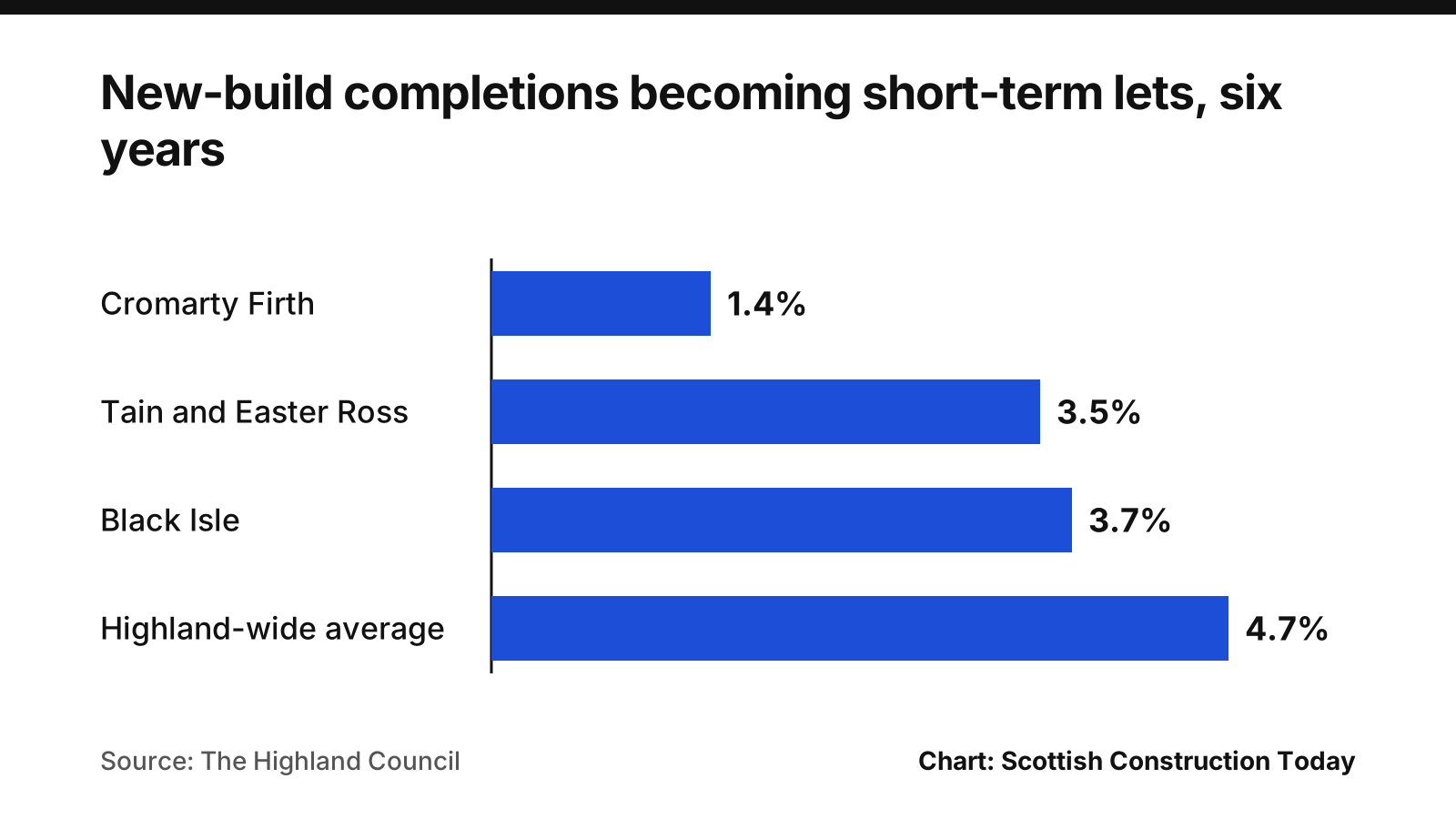
The council's update tracked the share of new-build housing completions over the past six years that went on to become short-term lets. All three wards came in under the Highland-wide average of 4.7%.
| Area | New-build completions becoming short-term lets |
|---|---|
| Cromarty Firth | 1.4% |
| Tain and Easter Ross | 3.5% |
| Black Isle | 3.7% |
| Highland-wide average | 4.7% |
A second measure, matching Registers of Scotland sales data against the public register, showed house sales later granted secondary letting licences at 1.0% in Cromarty Firth, 3.4% in Tain and Easter Ross and 1.8% in the Black Isle, against a Highland average of 4.7%.
The November 2025 assessment used a different metric, finding that 2% of potential dwellings in the area were licensed as short-term lets against a Highland-wide figure of 5% at that time.
What a control area would mean
Under Scottish Government guidance, a planning authority may designate all or any part of its area as a control area, subject to approval by Scottish Ministers. Within a designated area, a change of use of a dwellinghouse to short-term letting is deemed a material change and always requires planning permission.
The council already operates one such area. Badenoch and Strathspey (Ward 20) became a designated Short-Term Let Control Area on 4 March 2024, and the council said in May 2026 there were early signs it had slowed the growth of secondary short-term lets.
In May 2026 the council also opened a six-week consultation, from 12 May to 23 June, on two further proposed control areas. The Inverness City area would cover wards including Inverness West, Inverness Central and Inverness Ness-side, while the Highland Rural area would take in wards including Lochaber, Wester Ross, Strathpeffer and Lochalsh, and Sutherland.
Cllr Bill Lobban, Convener of The Highland Council, said at the time: "STLCAs are not a ban on short-term lets, and we recognise the important role they play in our visitor economy."
Bouchardon Bust sale
The committee also scrutinised Quarter 2 (April to September 2026) monitoring reports for the area's four Common Good Funds and noted a governance update on the sale of the Bouchardon Bust of Sir John Gordon, an asset of the Invergordon Common Good Fund.
The council said it had accepted an offer from a prospective UK buyer and entered an Option Agreement, triggering a five-month deferral period from 1 July 2026 to 1 December 2026 in which the buyer can raise the funds to complete the purchase. If the money is not raised by the deadline, the sale will proceed to the prospective overseas private buyer under the terms of the export licence.
The council said it is contractually bound to confidentiality and cannot name either purchaser, even though the UK buyer has publicly identified itself. Any request to extend the fundraising period would be a matter for the UK buyer and Arts Council England, not the council.
The UK Government placed a temporary export bar on the marble sculpture, signed and dated 1728, on 9 January 2026, with an initial deferral running to 8 April 2026. The Department for Culture, Media and Sport gave a recommended price for a UK buyer of £3,135,090 plus £620,000 VAT, which an eligible institution can reclaim. Its release linked the bust's subject to the development efforts that established Invergordon as a port on the Cromarty Firth.
The area committee first recommended a private sale to full council on 13 May 2024, when the council put the value at more than £2.5m. The bust was bought by Invergordon Town Council in 1930 for £5, according to the ledger, and the council said in 2024 the Invergordon fund had little else that could generate income. Members agreed then that a museum-quality replica should be commissioned.
Other business
Asset work across the Common Good Funds includes a focus on bringing the East Church Hall in Cromarty back into community use.
Members also received a progress update from Opportunity Black Isle on the Black Isle Place Plan. Current projects include exploring training and employment opportunities, investigating housing options across the Black Isle, contributing to plans for expanded community transport and exploring a winter ferry service for workers travelling to Nigg.
The UK buyer's fundraising period for the bust concludes on 1 December 2026.
On the record: The Highland Council
Sources
- The Highland Council (opens in a new tab) (accessed 2026-11-10)
- The Highland Council (opens in a new tab) (accessed 2026-11-10)
- The Highland Council (opens in a new tab) (accessed 2026-11-10)
- The Highland Council (opens in a new tab) (accessed 2026-11-10)
- Scottish Government (opens in a new tab) (accessed 2026-11-10)
- Department for Culture, Media and Sport (GOV.UK) (opens in a new tab) (accessed 2026-11-10)
- The Highland Council (opens in a new tab) (accessed 2026-11-10)
This story was researched from the primary sources above and checked against them before publication. Spotted an error? Tell us and we will correct it promptly.