policy
CITB says Highlands energy pipeline could double regional demand for construction workers
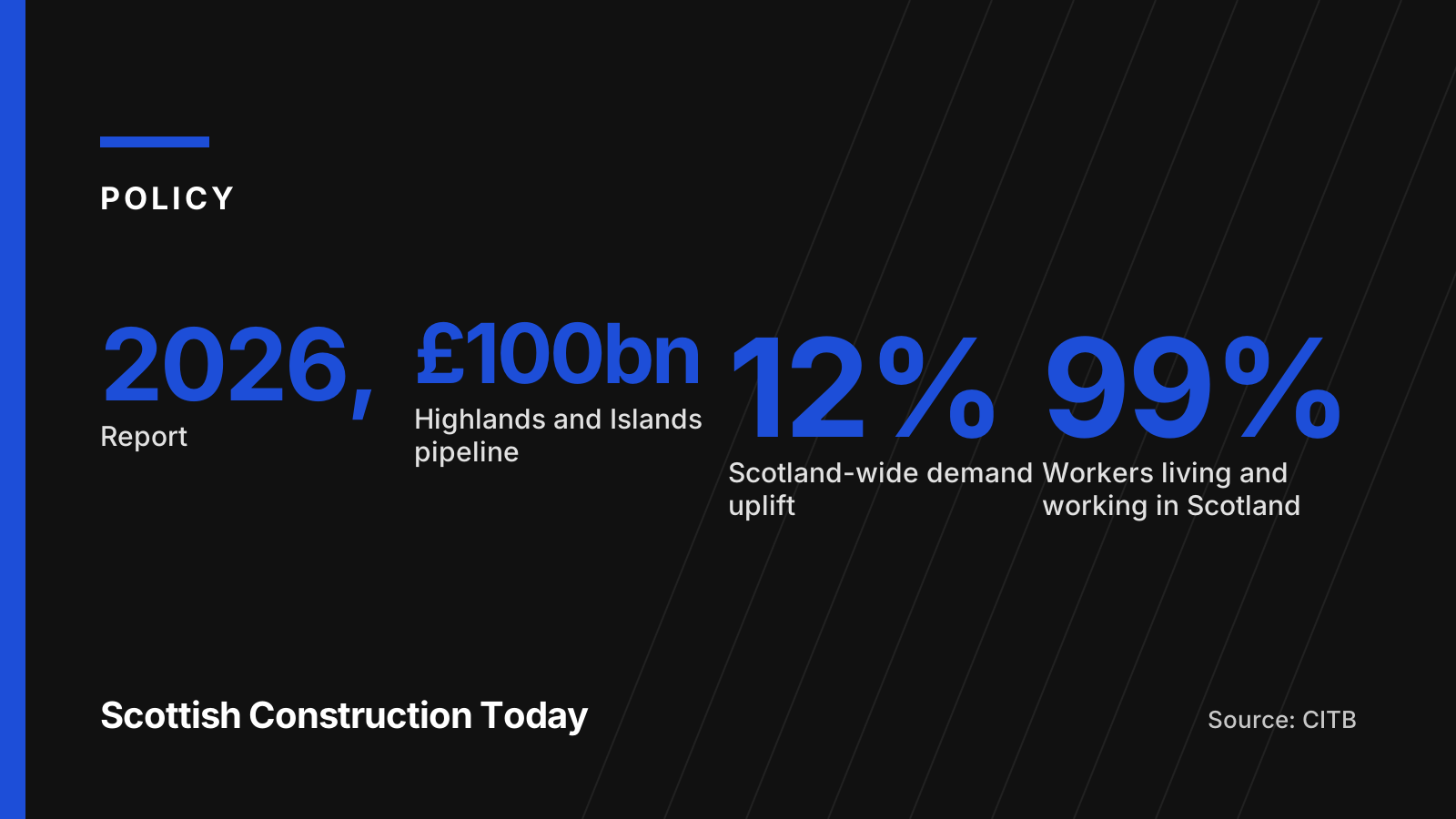
The training body's Local Skills Scotland 2026 report finds Scotland has enough construction capacity overall to 2030, but warns that a £100bn-plus Highlands and Islands pipeline would need a largely home-grown workforce.
The Construction Industry Training Board (CITB) has said Scotland's construction skills base needs investment to deliver a potential pipeline of more than £100bn of energy and infrastructure projects in the Highlands and Islands.
Its Local Skills Scotland 2026 report, published on 5 November, finds that Scotland is expected to have enough construction workforce capacity overall between 2026 and 2030, but that workers and skills are not spread evenly across the country.
According to CITB, proposed energy projects in the Highlands and Islands, including offshore wind, transmission networks, pumped storage hydro and green hydrogen, could more than double demand for construction workers in the area if they go ahead as planned. That regional rise would push construction workforce demand across Scotland up by about 12%.
Ian Hughes, CITB Engagement Director Scotland, said: "However, projects do not build themselves. Behind every wind farm, energy network, road, school or housing development is a skilled construction workforce."
A local workforce
The report argues that Scotland cannot rely on bringing in labour to meet that demand. CITB's research shows 99% of construction workers employed in Scotland both live and work in Scotland, and that they typically travel shorter distances than their counterparts elsewhere in the UK.
As a result, CITB said, future workforce needs are likely to be met mainly by developing local people through training and apprenticeships rather than by workers relocating from other parts of the UK.
The report recommends closer collaboration between industry, government, training providers and other stakeholders to understand future requirements and to make sure training provision matches what employers need.
The findings build on CITB's previous Local Skills Scotland report, published on 26 July 2023. That study found 94% of Scotland's construction workforce were living in Scotland when they started their careers and 76% had worked in Scotland for their whole career. It identified the Southeast of Scotland as the region with the largest gap between workforce supply and demand.
For UK-wide context, CITB's Construction Workforce Outlook 2026-2030 forecasts that the UK will need an average of 41,200 extra construction workers each year between 2026 and 2030.
Workforce North
CITB said the findings reinforce the case for Workforce North, which Skills Development Scotland (SDS) describes as a regional partnership connecting people, employers and partners with opportunities arising from investment in the Highlands and Islands. SDS puts the planned investment at more than £100bn over the next decade; CITB's release gives no timeframe for its figure.
Elaine Ellis, Skills Planning Manager (Construction and Net Zero) at Skills Development Scotland, said: "This research by CITB helps bring clarity to the scale of the workforce and skills challenge that sits behind the pipeline potential."
SDS lists the partnership's members as including SDS itself, the Scottish Funding Council and Inverness & Cromarty Firth Green Freeport, alongside Highlands and Islands Enterprise and the region's councils. SSEN Transmission, which said it now employs more than 2,500 people, reported that SDS, The Highland Council and Highlands and Islands Enterprise were among the partners at the initiative's launch in October 2025.
The Workforce North area covers Shetland, Orkney, Eilean Siar, Highland, Moray, Argyll & Bute and the islands of North Ayrshire, according to SDS.
The partnership has agreed an operational roadmap for the Highland Council area, in December 2025, and another for the Moray Council area, in September 2026, SDS said.
The co-investment fund
Alongside the roadmaps, SDS has set up a Workforce North Co-Investment Fund, which it says is anchored by £2m of SDS seed investment and initially focuses on green energy, construction, digital and STEM-related skills. The Highland Council administers the fund as lead partner and accountable body on behalf of the region, and the council describes it as a £2m fund.
The council said the fund is split into three streams, named Grow, Innovate and Accelerate. Councillor Raymond Bremner, Leader of The Highland Council, said the Highlands were entering a period of significant economic opportunity.
Frank Mitchell, Chair of SDS, said Workforce North's shared mission was to ensure the Highlands and Islands region has the workforce it needs.
Hughes said Scotland needed to plan ahead to meet the upcoming demand, and described Workforce North as an opportunity for industry, government and training providers to work together.
The full Local Skills Scotland 2026 report is available as a PDF from CITB, covering the forecast period from 2026 to 2030.
On the record: CITB, Skills Development Scotland, The Highland Council, Highlands and Islands Enterprise
Sources
- CITB (opens in a new tab) (accessed 2026-11-05)
- CITB (opens in a new tab) (accessed 2026-11-05)
- CITB (opens in a new tab) (accessed 2026-11-05)
- CITB (opens in a new tab) (accessed 2026-11-05)
- Skills Development Scotland (opens in a new tab) (accessed 2026-11-05)
- Skills Development Scotland (opens in a new tab) (accessed 2026-11-05)
- The Highland Council (opens in a new tab) (accessed 2026-11-05)
- SSEN Transmission (opens in a new tab) (accessed 2026-11-05)
This story was researched from the primary sources above and checked against them before publication. Spotted an error? Tell us and we will correct it promptly.